The Best Way to See Normandy: A Travel Advisor's Guide to the D-Day Beaches, Coast, and Countryside


Author: Cyndi Smith | Founder of Tailor Made Travel Studio & Overland Park travel advisor. Want more travel tips like these? Join my Facebook group.
Normandy is one of those rare places that delivers in so many ways.
History every where you turn. Coastline and countryside that look painted (because the Impressionists painted them). And a table heavy with cheese, cider, and apple brandy. Yes, please!
It's also one of the most misunderstood regions in France. People arrive expecting to "see Normandy" on a day trip from Paris and leave wishing they'd given it a week.
I'm Cyndi Smith, a travel advisor based in Overland Park, Kansas, and France is one of my favorite places to plan. After several visits and client trips to Normandy, I keep going back to learn more about the hotels, guides, and experiences in the region.
Here's the short version: the difference between a good Normandy trip and a great one isn't which sites you see. It's how you structure them. And there's more than one way to do it. It depends on how YOU like to travel.

At a glance: planning a trip to Normandy
Question | Quick answer |
How many days? | 3 to 4 for the highlights, a week to slow down |
Best home base | Bayeux, central to all five D-Day beaches |
Best months | May, June, and September |
Getting around | A car or private driver. Trains get you in and out. |
Don't miss | D-Day beaches, Mont-Saint-Michel, Honfleur |
How many days do you need in Normandy?
Three days is the absolute minimum, and only if you're laser-focused on the D-Day beaches. Four to five days is the sweet spot. That's enough to pair the WWII sites with Mont-Saint-Michel and a coastal town or two.
A week lets you slow down where it counts: a full day on the American D-Day sectors, a second on the British and Canadian ones, Mont-Saint-Michel at sunrise instead of in a crowd, and an afternoon doing nothing more ambitious than tasting Calvados in an apple orchard.
That pacing, depth over distance, is the whole point.
Three ways to plan your Normandy itinerary
The best way to experience Normandy depends on your interests and your pace. Most of my clients lean toward one of these three, then borrow a little from the others.
1. For the history lover
D-Day landing beaches: Omaha Beach, Utah Beach, and the Normandy American Cemetery at Colleville-sur-Mer. A guide brings the stories to life.
Bayeux: a charming medieval center and the perfect base for the beaches.
Caen Memorial: the region's most complete museum on World War II and the peace that followed.
Plan at least three days to see these without rushing.
2. For the scenery seeker
Étretat: walk the dramatic white chalk cliffs and natural arches.
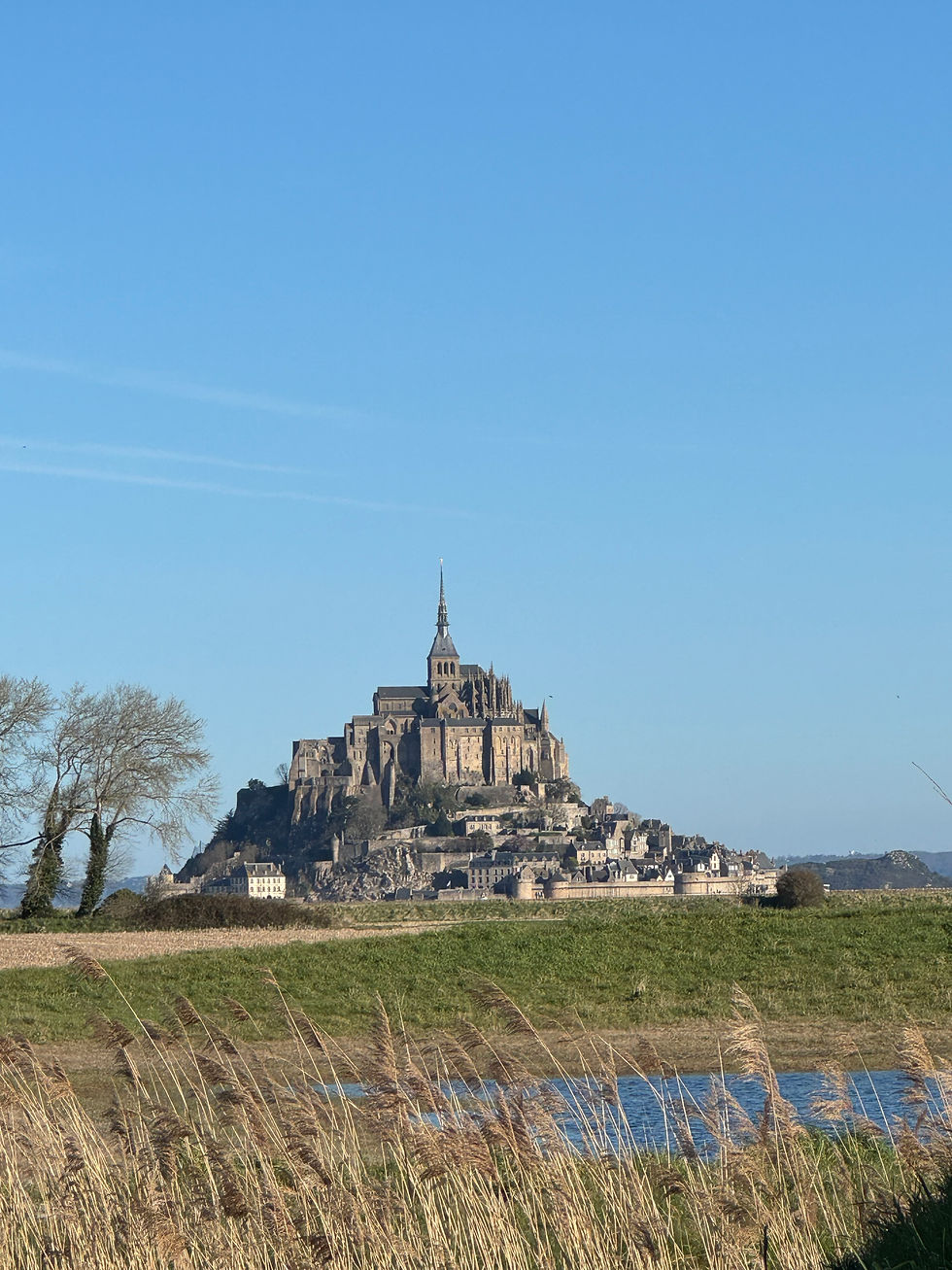
Mont-Saint-Michel: the island abbey that looks like it floated out of a storybook.
The countryside: apple orchards and half-timbered villages like Beuvron-en-Auge.
3. For the food and wine traveler
Camembert farms: see how the famous cheese is made, then taste it fresh.
The Cider Route: family-run cider houses through the Pays d'Auge.
Honfleur: oysters, mussels, and fresh fish in a picture-perfect harbor.
Calvados distilleries: learn how apple brandy is made, and enjoy a tasting.
Where should you stay in Normandy?
If you take one piece of advice from this guide, take this one: base yourself in Bayeux, especially if the D-Day sites are a priority. It's centrally located to all five landing sectors.
What I find most fascinating about Bayeux is that it's roughly 2,000 years old and came through World War II almost entirely intact. It was one of the first towns liberated after D-Day.
It has a magnificent Gothic cathedral, walkable medieval lanes, and a genuinely Norman feel rather than a polished resort atmosphere. And it sits right in the middle of the landing beaches, about 15 minutes from Omaha.
Heads up for 2026 and 2027: the Bayeux Tapestry museum is closed for renovation and plans to reopen in October 2027. The tapestry itself is on loan to the British Museum in London in the meantime. Bayeux is still the best base for the beaches. Just don't build your trip around the tapestry until it's home again.

Other places to stay: the pros and cons
Caen is the larger city, with better train connections to Paris and the excellent Caen Memorial. If you're relying on trains, it's a reasonable base. But Bayeux is more charming and closer to the beaches.
Honfleur is gorgeous (more on that below) and makes a wonderful first or last stop on your Normandy trip.


Deauville is elegant and perfect if you want a coastal vibe. It was built in the mid-1800s as a seaside resort, so it's "young" compared to Bayeux. The drawback: Omaha Beach is about an hour away.
The D-Day beaches: what to see
The landings stretched across five sectors: Utah, Omaha, Gold, Juno, and Sword, running west to east. Most visitors focus on the American sectors, and they're unmissable:
Pointe du Hoc: the best-preserved site, left almost exactly as it was in 1944.
Omaha Beach: home to the haunting Les Braves sculpture.
Normandy American Cemetery: at Colleville-sur-Mer, overlooking Omaha Beach.
Sainte-Mère-Église: where a paratrooper famously hung from the church steeple, now home to the Airborne Museum.
The British and Canadian sectors deserve their own day, too. Arromanches still shows the remains of the artificial Mulberry harbor offshore, and the Juno Beach Centre tells the often-overlooked Canadian story.
Planning to honor a family member who served? I wrote a separate guide to walking the Normandy beaches.
Can you visit the D-Day sites without a tour?
Yes. The beaches and the American Cemetery are public and free to visit. But the sites are spread out and many have surprisingly little signage, so the history can pass you by. Even confident drivers often book a private historian for one day, then explore on their own after that.

Mont-Saint-Michel: worth the hype
Yes, it's in Normandy (barely) and its right on the border with Brittany, which keeps the friendly debate alive. The abbey crowning the granite island is one of France's most astonishing sights, with roughly 1,300 years of layered history.
Two insider notes:
The tides are the show. At certain high tides the water surrounds the Mount almost completely, so timing your visit matters.
Stay overnight. When the day-trip buses leave in the late afternoon, the Mount empties out. You get the village and ramparts in a hush, then sunrise before the crowds return. There are simple hotels on the island and some lovely, more elevated stays just off it. Ask me about those.
Tip: it's a steep climb with hundreds of steps up to the abbey, so factor in mobility. A little planning makes it work for almost everyone, including grandparents and grandkids traveling together.
For more, see my Mont-Saint-Michel travel guide.
The prettiest towns in Normandy (and the ones no one tells you about)
Normandy has no single "prettiest" town, but a few are perennial winners. Honfleur is often called one of the most beautiful ports in France. Its Vieux Bassin, lined with tall slate-faced houses, is the harbor the Impressionists loved to paint. Étretat has the cliffs, and Beuvron-en-Auge is a postcard of half-timbered houses.
Here's where I like to go beyond the standard list. Head to the Cotentin peninsula in the far northwest and you'll find a Normandy most first-timers never see: Barfleur, one of France's Most Beautiful Villages, and Saint-Vaast-la-Hougue, famous for its oysters.
What to eat and drink: the 4 C's of Normandy
Camembert: the soft cheese made from the milk of local Normande cows.
Cidre: dry and lightly sparkling here, not the sweet stuff.
Cream: the backbone of Normandy's rich, buttery sauces.
Calvados: the region's amber apple brandy, distilled from cider and aged in oak.
Don't confuse Calvados with Pommeau, a softer aperitif that blends apple juice with young Calvados. It's the one I usually point first-timers to.
Normandy's Michelin-starred restaurants
All that cream, cider, seafood, and orchard fruit has quietly made Normandy serious Michelin country. The region has more than a dozen starred restaurants, and a starred dinner is one of the loveliest ways to taste it at its most refined. A few I point clients to:
L'Odas, Rouen: a no-menu "surprise" tasting built on Normandy ingredients, served in a 16th-century mansion.
Le Jardin des Plumes, Giverny: steps from Monet's house, with chef David Gallienne's nature-led cooking in a 1912 villa with a sculpture garden.
Maximin Hellio, Deauville: tasting menus that turn local seafood and produce into something special.
Le Pily, Cherbourg: an intimate table on the wild Cotentin tip, proof the far northwest is no culinary afterthought.
Each holds one star in the current Michelin Guide. In Normandy, the everyday ingredients are the luxury. See all Michelin restaurants in Normandy.
Getting around Normandy: the part everyone underestimates
Normandy is a driving region. A car or a private driver gives you the freedom to reach the small villages and remote sites. Trains are great for getting into and out of the region.
Paris to Bayeux: about two hours by train, sometimes with a quick connection in Caen.
Mont-Saint-Michel to Paris: no direct train. Take a shuttle to Rennes, then the high-speed TGV, about four hours in all.
Driving: plan routes that avoid backtracking. Roads can be narrow and winding, and rural cell coverage is spotty, so download offline maps.
Book early: May, June, and September fill up fast.
Not excited about driving in a foreign country? A private driver for your D-Day day (and beyond) takes all of that off your plate. I build it right into your plan.
Tips for enjoying Normandy like a local
Learn a few French phrases. A simple bonjour goes a long way. Always say this as you enter a business
Visit markets early. Produce, cheese, and baked goods are best in the morning.
Try the local specialties, like teurgoule (a cinnamon rice pudding).
Take your time. Slow down, chat with locals, and savor your meals.
Brittany vs. Normandy: which is nicer?
Neither is "better." They're different trips. Choose Normandy for World War II history, Impressionist art and Giverny, half-timbered towns, and that cheese-and-cider table. Choose Brittany for a wilder, more rugged coastline and Celtic heritage.
Is Normandy expensive? And what should you wear?
Normandy is moderately priced by French standards, generally gentler than Paris or the Riviera, with everything from cozy guesthouses to luxury châteaux. Where you spend or save comes down to your hotels and how you get around.
As for what to wear: layers and comfortable, broken-in walking shoes. You'll be on pebbly beaches, cobblestone lanes, and abbey stairs, often in the same day, and the coastal weather changes its mind quickly. Pack a light rain jacket, even in summer.
A sample 7-night Normandy itinerary
This is the shape I build most often. It runs east to west, so the drives always move forward and the trip ends on Mont-Saint-Michel's high note.
Stop | Nights | Highlights |
Honfleur | 2 | Arrive from Paris via Giverny. The Impressionist harbor and a Calvados tasting. |
Bayeux | 3 | A day on the American D-Day sectors, a day on the British and Canadian sectors plus the Caen Memorial, and time in the medieval town. |
Mont-Saint-Michel | 2 | The abbey, the bay, and the Mount at dusk and dawn without the crowds. |
Prefer more of the hidden coast? Swap a night for the Cotentin and its oysters. Want it gentler? Linger longer at the abbey. The bones flex easily.
Tailor Made Takeaway
Normandy rewards the traveler who slows down. Pick one great home base, give the beaches the time they deserve, and leave room for a long lunch. That's how Normandy goes from a checklist to a trip you'll talk about for years.
Whether it's your first trip to France or you're honoring a family member who served, I'll help you plan Normandy with the right pace, the right guides, and the right home base.
Frequently Asked Questions
How many days do you need in Normandy? Two days is the minimum for the D-Day highlights. Three to four is ideal for adding Mont-Saint-Michel and a coastal town, and a full week lets you see the region without rushing.
What is the best town to stay in to see Normandy? My favorite is Bayeux. It's central to the D-Day beaches, full of medieval character, and survived the war almost intact. Caen is a good alternative if you're traveling by train.
What is the prettiest town in Normandy? Honfleur is the classic answer for its painterly harbor, with Étretat (cliffs) and Beuvron-en-Auge (half-timbered village) close behind.
Can you see the Bayeux Tapestry in 2026 or 2027? Not in Bayeux. The museum is closed for renovation and plans to reopen in October 2027, and the tapestry is on loan to the British Museum in London in the meantime.
What drink is Normandy famous for? Calvados, an apple brandy distilled from local cider and aged in oak. The region is also known for dry cider and Pommeau.
What are the 4 C's of Normandy? Camembert, cider, Calvados, and cream.
What is the best month to visit Normandy? May, June, and September offer the best balance of weather and smaller crowds. June brings the D-Day anniversary commemorations, so book early.
Can you visit Normandy without a tour? Yes. A rental car makes it very doable, since public transportation between the sites is limited. Many travelers still book a private guide for their D-Day day.
How long is the train from Paris to Normandy? Paris to Bayeux takes about two hours, sometimes with a connection in Caen. Book early for the best fares.
Is Mont-Saint-Michel in Normandy or Brittany? Normandy, though it sits right on the border with Brittany.
Is there Uber in Normandy? Not reliably outside the larger cities. Plan on a car or a private driver for touring.
Is there a France travel advisor near Kansas City? Yes, that's me! I'm Cyndi Smith, founder of Tailor Made Travel Studio in Overland Park, Kansas. I plan custom France trips, including Normandy, for travelers across the Kansas City area and beyond.

Let's plan your Normandy trip
Hi, I'm Cyndi Smith, a passionate traveler and owner of Tailor Made Travel Studio. I craft tailored travel experiences for busy people who want to travel the world with ease and a little bit of luxury!
Dreaming of Normandy or a trip through France? Book a complimentary call and let's talk it through.
You can also find my ship tours and travel tips on YouTube.


Comments